Uncategorized
That stale smoke odor hits fast – usually the second you open the door, and definitely before the AC even kicks on. If you’re searching for how to remove smoke smell from car interiors, the real issue is not masking the odor. It is removing the residue that keeps releasing that smell from fabric, leather, plastic, carpet, and the ventilation system.
Smoke odor is stubborn because it does not sit in one place. It clings to headliners, settles into seat foam, coats hard surfaces with invisible film, and gets pulled through the cabin air system. That is why air fresheners rarely do much beyond covering it for a day or two. If you want the interior to smell clean again, you need a methodical reset.
Why smoke smell lingers in a car
Inside a vehicle, smoke has nowhere to go. The cabin is a compact, enclosed environment with lots of soft materials and textured surfaces. Every time someone smokes, tiny particles and oily residue settle deeper into the interior. Heat and humidity, both common in Florida, can make that odor resurface even after a light cleaning.
The headliner is often one of the biggest problem areas because it absorbs odor easily but cannot be aggressively scrubbed without risking damage. Seats and carpet hold smell in their fibers and padding. Door panels, dashboards, and glass collect residue too, which is why windows often develop a hazy film in a smoker’s car.
Then there is the HVAC system. If smoke has been pulled through the vents for months or years, the odor can keep circulating every time you run the fan.
How to remove smoke smell from car interiors the right way
The most effective approach is a full interior decontamination, not a quick spray-and-go fix. Start by removing obvious odor sources. Empty the vehicle completely, including the trunk, center console, seat pockets, and any storage compartments. Old ash, cigarette butts, and smoke-contaminated paper items will continue adding odor if they stay inside.
Once the cabin is cleared out, vacuum thoroughly. Focus on seats, carpet, floor mats, under the seats, and along creases where ash and residue collect. Vacuuming will not remove the smell by itself, but it clears out loose contamination so the deeper cleaning steps can work properly.
Clean every hard surface
Wipe down all interior hard surfaces with an appropriate interior cleaner. That includes the dashboard, center console, cupholders, steering wheel, door panels, trim, and all interior glass. This step matters more than many people realize. Smoke leaves behind a film, and if that film stays in place, the smell stays with it.
Use a clean microfiber towel and change towels often. If the towel starts coming away yellow or brown, you are removing built-up residue. Glass should be cleaned separately until it no longer has that smoky haze.
Treat fabric, carpet, and mats
If the vehicle has cloth seats or carpeted mats, shampooing or extraction is usually necessary. A surface wipe will not reach the contamination trapped below the fibers. Use an interior-safe fabric cleaner, agitate gently, and extract as much moisture and residue as possible.
The same goes for carpet. Pay close attention to the driver’s footwell, under-seat areas, and the trunk. Smoke odor can settle into areas that are easy to miss during routine cleaning.
This is also where trade-offs matter. Too little cleaning leaves odor behind. Too much water, especially without proper extraction and drying, can create a new problem with mildew or musty smells. Controlled cleaning and thorough drying are critical.
Clean leather carefully
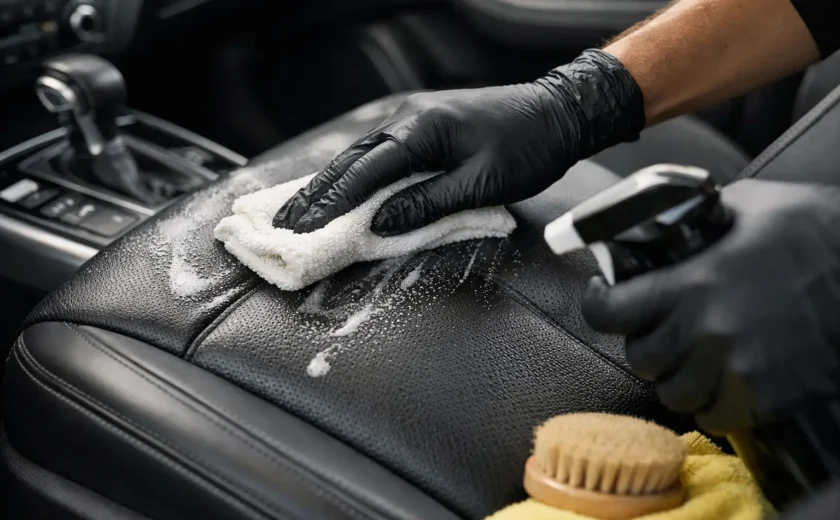
Leather interiors still absorb smoke, just differently than cloth. The smell can sit in seams, perforations, and the residue layer on the surface. Use a quality leather-safe cleaner, work section by section, and follow with conditioner if appropriate for the material.
Avoid over-saturating perforated leather. Liquid pushed too deeply into the seat can be hard to remove and may affect the foam underneath.
Do not ignore the headliner
The headliner often carries a large share of the odor load, but it has to be handled with care. The adhesive behind it can fail if the material gets too wet or is scrubbed aggressively. Light cleaning with a dedicated interior cleaner and gentle blotting is safer than heavy saturation.
If smoke odor is severe, this is one of the areas where professional detailing makes a noticeable difference. The goal is to reduce contamination without damaging a very delicate surface.
The cabin air system is often the hidden source
A lot of people clean the seats and carpet, then wonder why the car still smells like smoke when the AC turns on. In many cases, the cabin air filter is holding odor and the evaporator area has absorbed it as well.
Replace the cabin air filter if the vehicle has one. If it is heavily contaminated, keeping the old filter in place can keep pushing odor back into the cabin. After that, run the fan and use an HVAC-safe odor treatment designed for automotive systems.
It depends on how long the car was smoked in. In a lightly affected vehicle, replacing the filter and cleaning the interior may be enough. In a heavily affected one, the ventilation system may need a more thorough treatment to fully reset the smell.
Odor neutralizers can help, but they are not the first step
After deep cleaning, an odor neutralizer can be useful. The key phrase is after deep cleaning. If you use one before removing the residue, it is trying to fight a source that is still active.
Enzyme-based or odor-neutralizing products can help with lingering smell in fabric and carpet. Some vehicles also benefit from ozone or similar professional odor-treatment equipment. These methods can be effective, but they are not magic. If the interior still has heavy smoke residue on surfaces, the odor often returns.
That is why the best results come from combining physical cleaning, extraction, filter replacement, and targeted deodorization.
What usually does not work well
People understandably want a shortcut, especially if the car otherwise looks clean. Unfortunately, smoke odor does not respond well to shortcut solutions.
Air fresheners tend to layer fragrance over the problem. Baking soda can help slightly on removable mats or fabric in mild cases, but it is rarely enough for a smoker’s car. Scent bombs and hanging deodorizers may make the cabin smell stronger, not cleaner. And household cleaners can stain, dry out, or discolor interior materials if they are not designed for automotive use.
If the odor has been present for a long time, surface-level remedies usually lead to frustration. The smell may seem reduced for a day or two, then come back once the cabin heats up.
When DIY is enough and when it is time for professional help
If the smoke exposure was brief, such as one previous owner who smoked occasionally, a careful DIY process may get you where you want to be. That usually means a full vacuum, hard-surface cleaning, fabric or leather treatment, cabin air filter replacement, and a follow-up deodorizing step.
If the smell is strong, baked into the headliner, or returns every time the car sits in the sun, professional interior detailing is often the better route. Severe smoke contamination is less about basic cleaning and more about systematic decontamination. It takes the right tools, safe chemistry, extraction capability, and experience with sensitive surfaces.
For owners who care about presentation, comfort, and long-term value, this is one area where quality work shows quickly. A properly restored interior does not just smell better. It feels cleaner, looks sharper, and creates a noticeably better driving environment.
A realistic expectation matters
Most smoke-affected vehicles can be improved dramatically. Many can be brought back to a clean, neutral interior. But results depend on severity, how long the odor has been there, the materials in the cabin, and whether the HVAC system is part of the problem.
In extreme cases, especially in older vehicles with years of heavy smoking, one round of cleaning may not fully solve it. A second treatment or more advanced odor remediation may be needed. That is not a sign the process failed. It simply means the contamination level was deeper than a single pass could remove.
At a premium level of care, the goal is not to cover the issue. It is to correct it with precision. If you want to know how to remove smoke smell from car interiors and get lasting results, think beyond fragrance and focus on contamination removal from every surface the smoke touched.
A clean interior should smell like nothing at all – just a well-kept vehicle that feels right the moment you step inside.